

BE THE FIRST TO KNOW
Find out about camps, scholarships, child care, family events, our advocacy work, and more.
BE THE FIRST TO KNOW
Find out about camps, scholarships, child care, family events, our advocacy work, and more.
Military Child Education
Thanks to frequent PCS moves, military-connected kids experience far more school transitions than their civilian counterparts.
It’s not unusual for a military kid to attend five or more schools between kindergarten and their senior year of high school!

School Liaison Officers (SLOs)
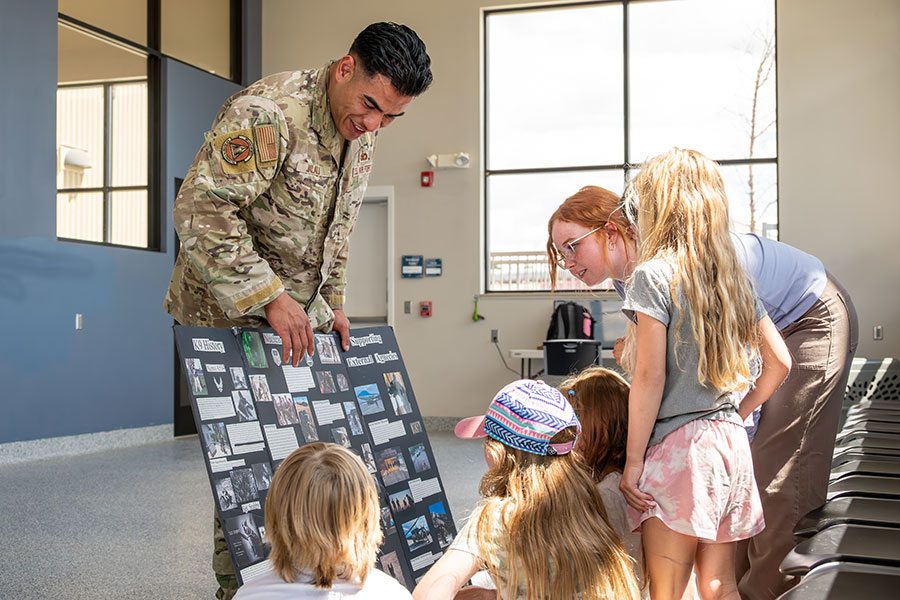
Installation School Liaison Officers are the primary point of contact for PK-12th grade school-related matters. They can provide information about local schools in your community, graduation requirements, after-school programs, homeschool support services, and more. You can find your local SLO at Military OneSource’s Installation directory.
The Interstate Compact on Educational Opportunity for Military Children
Families transitioning to new school districts confront new laws and policies affecting everything from kindergarten entrance age to high school graduation requirements. In the past, those varying state laws could complicate a military child’s transition to their new school. To address that problem, the Interstate Compact on Educational Opportunity for Military Children was created. The Compact is an agreement that was passed into law by all 50 states and the District of Columbia. The intent is to address the most common barriers faced by military-connected students moving to new schools and ensure a successful transition.
Specifically, the Compact addresses:
Enrollment
Schools should accept unofficial or hand-carried records when enrolling your child, rather than waiting to receive an official transcript from their previous school.
Placement
If your child was receiving special education services at their old school, the new school should place them in a comparable program. The new school may conduct its own evaluation later to make sure your student is appropriately placed.
Attendance
Districts should allow military kids to miss school to attend deployment-related activities.
Eligibility
Regardless of age, your student should be able to continue at the grade level they were enrolled in at their previous school.
Graduation
Schools should waive specific course or exam requirements for students transferring during their senior year if necessary to allow the student to graduate on time.
The Interstate Compact covers military children of active duty and activated Guard and Reserve service members who are enrolled in public schools in grades K through 12. The Compact also covers children of fallen service members, as well as those who are medically retired or discharged, for one year following the service member’s death, retirement, or discharge.
Even though the Compact is recognized by all 50 states and D.C., you may find that teachers and administrators at your child’s new school aren’t familiar with the law and its requirements, resulting in possible conflict. If this happens to your family, here are a few resources to help your child make a smoother transition between schools:

- Educate yourself and your child’s school: The Military Interstate Children’s Compact Commission (MIC3) has created a variety of downloadable brochures, webinars and other resources to help educators and parents learn more about the Compact.
- Reach out to your Installation School Liaison Officer (SLO): SLOs can work with your child’s school administrators to make sure they know and understand the Interstate Compact. They can also help teachers and school personnel understand the challenges faced by military kids and families.
- Contact your Interstate Compact officials: Each state appoints a representative to serve on the Interstate Compact Commission. That person, the state Commissioner, is responsible for making sure that the rules are being implemented in their state. Find information on your state Compact commissioner here. If you’re concerned that your child’s school district isn’t following the Compact, contact your state Compact commissioner or Compact Commission officials directly.

The Compact and Special Needs Children
Military families with special needs children face unique challenges related to the Individualized Education Program (IEP) process. Here are helpful resources on the Individuals with Disabilities Education Act (IDEA) and state contact information for questions and concerns.
In-State Tuition
Public colleges and universities typically offer two different tuition rates: one for in-state residents and one for out of state residents. The tuition rate for out-of-state residents is usually much higher than the in-state rate.
Military families who move frequently often have a difficult time meeting state standards to qualify for in-state tuition rates.
Eligibility guidelines vary from state to state, but most require that the student or their family live, own property, and/or pay that state’s taxes to be considered for in-state tuition. In the past, this has put military families at a disadvantage since they are often legal residents of another state.
Luckily, the playing field was leveled for military families in 2009 when the Higher Education Opportunity Act (HEOA) was passed; requiring public colleges and universities to grant in-state tuition status to dependent children of active duty service members in the state where they reside, or are permanently stationed.
Once enrolled and paying in-state tuition, your child will continue to pay the in-state tuition rate as long as they remain continuously enrolled at the institution, even if the service member is reassigned outside the state.
Post-9/11 GI Bill
One of the most valuable education benefits available for military families is the Post-9/11 GI Bill.
Service members have the option of transferring some or all of their GI Bill benefit to their dependent spouses and children. Service members can choose to transfer the entire 36 month benefit to one family member, or divide it among their spouse and/or children. In addition to covering tuition expenses, eligible beneficiaries may receive a book stipend, as well as a housing allowance.
Service members can apply to transfer their Post-9/11 GI Bill benefits online through the MilConnect portal. Step-by-step instructions are available on the MilConnect website.
The rules and regulations regarding Post-9/11 GI Bill transferability are complex. We recommend following the links above to ensure you are receiving the most accurate and up-to-date information directly from the source.
Specific questions about paying for your child’s education should be directed to the financial aid office at your child’s college or university. Those offices are familiar with programs and policies supporting military families and are often willing to work with families to make college affordable for military kids.

BE THE FIRST TO KNOW
Find out about camps, scholarships, child care, family events, our advocacy work, and more.
BE THE FIRST TO KNOW
Find out about camps, scholarships, child care, family events, our advocacy work, and more.
Read More of Our Child Education Articles


We Need Your Help More Than Ever